Thick films - parasites identification: Difference between revisions
From MalariaETC
No edit summary |
No edit summary |
||
| Line 14: | Line 14: | ||
---- | ---- | ||
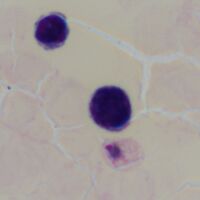
<span style="font-size:90%">Early trophozoite forms</span> | <span style="font-size:90%">Early trophozoite forms (''P.ovale'')</span> | ||
<gallery mode="nolines" heights=200px widths=200px> | <gallery mode="nolines" heights=200px widths=200px> | ||
File:4 ET_PO.jpg|link={{filepath:4 ET_PO_anno.jpg}} | File:4 ET_PO.jpg|A|link={{filepath:4 ET_PO_anno.jpg}} | ||
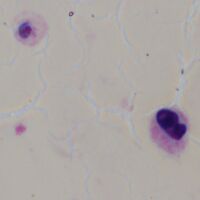
File:4 LT_PO.jpg|link={{filepath:4 LT_PO_anno.jpg}} | File:4 LT_PO.jpg|B|link={{filepath:4 LT_PO_anno.jpg}} | ||
</gallery> | </gallery> | ||
---- | ---- | ||
Revision as of 15:00, 27 February 2025
Navigation
>Main Malaria Index
>>Thick film - main page
>>>Current page: Parasite identification using thick films
Recognising specific parasite features on malaria thick films
In some species and parasite forms the morphology will be better preserved allowing a more confident identification and assignment of either parasite developmental stage, species or associated species. This can vary within the preparation according to the thickness of the preparation and the relative rsistance to lysis. Some examples are given below:
NOTE: the images are at relatively low magnification - to view them properly please click on the image to view in larger annotated form, then use the "back" button on your browser to return to the referring page.
Early trophozoite forms (P.ovale)
-
A
-
B


Late trophozoite forms


Schizont forms


Gametocyte forms


Malaria pigment

