Thick films - parasites and debris: Difference between revisions
From MalariaETC
No edit summary |
No edit summary |
||
| Line 7: | Line 7: | ||
</span> | </span> | ||
---- | ---- | ||
<span style="font-size:90%">'''Recognising "debris"'''</br>The parasites on a thick film lie within a background of white cells, platelets and various red cell components that have not been fully lysed. It is important to recognise these different features (which may vary a little between films depending on thickness and staining). A film area without parasites is shown below.</span> | <span style="font-size:90%">'''Recognising "debris" on thick films'''</br>The parasites on a thick film lie within a background of white cells, platelets and various red cell components that have not been fully lysed. It is important to recognise these different features (which may vary a little between films depending on thickness and staining). A film area without parasites is shown below.</span> | ||
</br></br> | </br></br> | ||
<gallery mode="nolines" heights=200px widths=200px> | <gallery mode="nolines" heights=200px widths=200px> | ||
Revision as of 14:21, 21 February 2025
Navigation
>Main Malaria Index
>>Thick film - main page
>>>Current page: Distinguishing features on thick film
Recognising "debris" on thick films
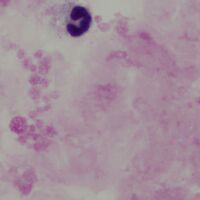
The parasites on a thick film lie within a background of white cells, platelets and various red cell components that have not been fully lysed. It is important to recognise these different features (which may vary a little between films depending on thickness and staining). A film area without parasites is shown below.
-
A
-
B


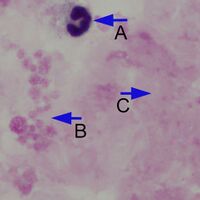
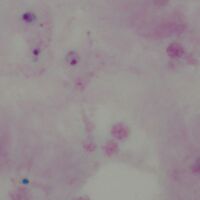
Normal background elements of a thick malaria film. The neutrophil (A) is recognisable by the characteristic nuclear shape but show artefactual distortion: in this case the chromatin detail is lost and there is no visible membrane outline or granular content. A careful look at the group of structures (B) suggests that they are part of a large group of clumped platelets formed when the film was prepared. Finally, the more amorphous material (C) most likely represents fibrin clot and un-lysed red cell debris.
-
A
-

B


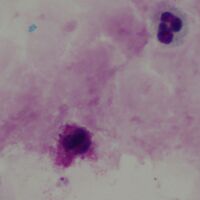
Subtle single parasite
-
A
-

B


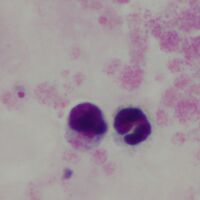
Two parasites with debris
-
A
-

B


3 parasites