Thick films - parasites and debris: Difference between revisions
From MalariaETC
No edit summary |
No edit summary |
||
| Line 35: | Line 35: | ||
<gallery mode="nolines" heights=200px widths=200px> | <gallery mode="nolines" heights=200px widths=200px> | ||
File:13 Mess & troph.jpg|<span style="font-size:80%">Low magnification view for scale, 3 regions marked</span>|link={{filepath:13 Mess & troph.jpg}} | File:13 Mess & troph.jpg|<span style="font-size:80%">Low magnification view for scale, 3 regions marked</span>|link={{filepath:13 Mess & troph.jpg}} | ||
File: | File:14 Mess & troph anno.jpg|<span style="font-size:80%">Low magnification view for scale, 3 regions marked</span>|link={{filepath:14 Mess & troph anno.jpg}} | ||
</gallery> | </gallery> | ||
</br> | </br> | ||
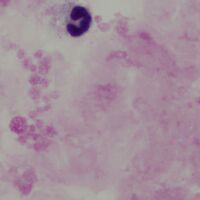
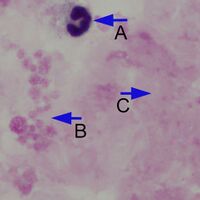
<span style="font-size:90%">Note the differences in recognition - the typical ring form and vacuole of the parasite are not as easy to distinguish and chromatin dots may appear to separate from parasite cytoplasm while the absence of intact red cells takes away important clues to parasite size, distribution within the red cell, and any red cell changes. This is illustrated in the image below</span> | <span style="font-size:90%">Note the differences in recognition - the typical ring form and vacuole of the parasite are not as easy to distinguish and chromatin dots may appear to separate from parasite cytoplasm while the absence of intact red cells takes away important clues to parasite size, distribution within the red cell, and any red cell changes. This is illustrated in the image below</span> | ||
---- | ---- | ||
Revision as of 19:40, 14 February 2025
Navigation
>Main Malaria Index
>>Thick film - main page
>>>Current page: Distinguishing features on thick film
-
Low magnification view for scale, 3 regions marked
-
Low magnification view for scale, 3 regions marked


Note the differences in recognition - the typical ring form and vacuole of the parasite are not as easy to distinguish and chromatin dots may appear to separate from parasite cytoplasm while the absence of intact red cells takes away important clues to parasite size, distribution within the red cell, and any red cell changes. This is illustrated in the image below
-
Low magnification view for scale, 3 regions marked
-

Low magnification view for scale, 3 regions marked
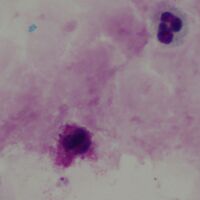
Note the differences in recognition - the typical ring form and vacuole of the parasite are not as easy to distinguish and chromatin dots may appear to separate from parasite cytoplasm while the absence of intact red cells takes away important clues to parasite size, distribution within the red cell, and any red cell changes. This is illustrated in the image below
-
Low magnification view for scale, 3 regions marked
-

Low magnification view for scale, 3 regions marked


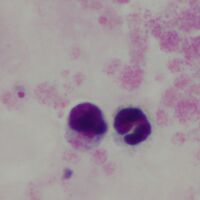
Note the differences in recognition - the typical ring form and vacuole of the parasite are not as easy to distinguish and chromatin dots may appear to separate from parasite cytoplasm while the absence of intact red cells takes away important clues to parasite size, distribution within the red cell, and any red cell changes. This is illustrated in the image below
-
Low magnification view for scale, 3 regions marked
-

Low magnification view for scale, 3 regions marked

Note the differences in recognition - the typical ring form and vacuole of the parasite are not as easy to distinguish and chromatin dots may appear to separate from parasite cytoplasm while the absence of intact red cells takes away important clues to parasite size, distribution within the red cell, and any red cell changes. This is illustrated in the image below