Thick vs Thin film comparison: Difference between revisions
From MalariaETC
No edit summary |
No edit summary |
||
| Line 15: | Line 15: | ||
</gallery> | </gallery> | ||
</br> | </br> | ||
<span style="font-size:90%;">There is no single correct choice of staining, essentially the thin film has many advantages in terms of ease of preparation, staining and identification. | <span style="font-size:90%;">There is no single correct choice of staining, essentially the thin film has many advantages in terms of ease of preparation, staining and identification. In contrast the thick malarial film offers a single but significant advantage: that of superior sensitivity for parasite detection.< It is important to appreciate these strengths and weaknesses.</span></br></br> | ||
---- | ---- | ||
</br> | </br> | ||
Revision as of 21:01, 20 February 2025
Navigation
>Main Malaria Index
>>Thick film - main page
>>>Current page: Thick film vs thin film
Relative merits of thick or thin films in malaria diagnosis
-
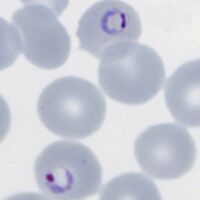
Thin film appearances P.falciparum
-
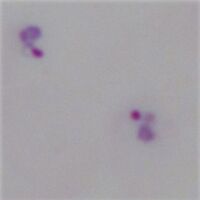
Thick film appearances P.falciparum


There is no single correct choice of staining, essentially the thin film has many advantages in terms of ease of preparation, staining and identification. In contrast the thick malarial film offers a single but significant advantage: that of superior sensitivity for parasite detection.< It is important to appreciate these strengths and weaknesses.
| 1. Sensitivity for detection |
|---|
| Thick film: Higher - can detect lower levels of parasitaemia ~5–10 parasites/µL |
| Thin film: Lower - generally requires ~50 parasites/µL for reliable detection |
| 2. Species Identification |
| Poor: poor - red cell morphology is lost and species-specific features may not be seen |
| Thin film: Good - both parasite morphology and RBC characteristics are assessed |
| 3. Quantification of parasite number |
| Difficult: red cells are not seen so requires estimation and is therefore imprecise |
| Easier: parasites can be counted counted directly and assessed as a proportion of red cells |
| 4. Preparation and staining considerations |
| Less easy: requires air drying and careful spreading and staining to minimise any artefact |
| Easier: films are fixed and stained immediately with clearer morphology of parasites and red cells |