Thick vs Thin film comparison: Difference between revisions
From MalariaETC
No edit summary |
No edit summary |
||
| Line 46: | Line 46: | ||
|- | |- | ||
| Thin film: Good - both parasite morphology and RBC characteristics are assessed | | Thin film: Good - both parasite morphology and RBC characteristics are assessed | ||
|- | |||
!'''3. Quantification of parasite number''' | |||
|- | |||
| Difficult: red cells are not seen so requires estimation and is therefore imprecise | |||
|- | |||
| Easier: parasites can be counted counted directly and assessed as a proportion of red cells | |||
|} | |} | ||
---- | ---- | ||
Revision as of 14:11, 14 February 2025
Navigation
>Main Malaria Index
>>Thick film - main page
>>>Current page: Thick film vs thin film
Relative merits of thick or thin films in malaria diagnosis
-
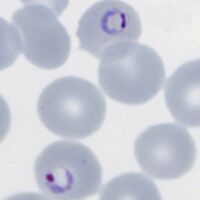
Thin film appearances P.falciparum
-
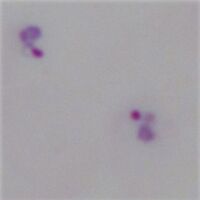
Thick film appearances P.falciparum


|
| ||
| Feature | Thick Film | Thin Film |
|---|---|---|
| Sensitivity for detection | Higher: detects low parasitaemia ~5–10 parasites/µL | Lower: generally needs ~50 parasites/µL for reliable detection) |
| Species Identification | Poor: RBC morphology lost and species-specific features may be difficult | Excellent: Parasite morphology and RBC characteristics are readily observed |
| Quantification of parasitaemia | Difficult: requires estimation so is imprecise | Easier: parasites can be counted per number of RBCs |
| Preparation and staining | Longer: requires air drying before careful staining to avoid artefact | Faster: films are fixed and stained immediately with clearer morphology |
| 1. Sensitivity for detection |
|---|
| Thick film: Higher - can detect lower levels of parasitaemia ~5–10 parasites/µL |
| Thin film: Lower - generally requires ~50 parasites/µL for reliable detection |
| 2. Species Identification |
| Poor: poor - red cell morphology is lost and species-specific features may not be seen |
| Thin film: Good - both parasite morphology and RBC characteristics are assessed |
| 3. Quantification of parasite number |
| Difficult: red cells are not seen so requires estimation and is therefore imprecise |
| Easier: parasites can be counted counted directly and assessed as a proportion of red cells |