P.falciparum early trophozoites gallery: Difference between revisions
From MalariaETC
No edit summary |
No edit summary |
||
| Line 1: | Line 1: | ||
{{DISPLAYTITLE:<span style="position: absolute; clip: rect(1px 1px 1px 1px); clip: rect(1px, 1px, 1px, 1px);">{{FULLPAGENAME}}</span>}} | {{DISPLAYTITLE:<span style="position: absolute; clip: rect(1px 1px 1px 1px); clip: rect(1px, 1px, 1px, 1px);">{{FULLPAGENAME}}</span>}} | ||
{| class="wikitable" style="width: | {| class="wikitable" style="width: 60%; border-style: none; border-width: 0px; border-color: gainsboro; color:black" | ||
|style = "font-size:90%; color:black; background: gainsboro |'''Navigation'''</br> | |style = "font-size:90%; color:black; background: gainsboro |'''Navigation'''</br> | ||
|- | |- | ||
|} | |||
</br> | |||
|<span style="font-size:90%">>[[Plasmodium_falciparum:_Morphology|BACK]]''</span></br> | |<span style="font-size:90%">>[[Plasmodium_falciparum:_Morphology|BACK]]''</span></br> | ||
---- | ---- | ||
Revision as of 15:01, 20 December 2024
| Navigation |
|>BACK
P.falciparum
Small delicate rings, and these may be the only forms seen in some patients at diagnosis. Infected red cells have normal (or slightly crenated) appearance.
-
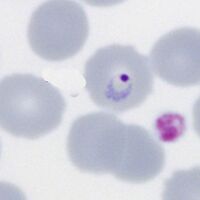
Fine ring form
-
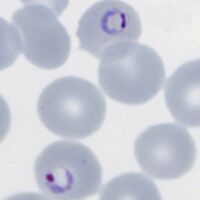
Double dot form and normal ring
-
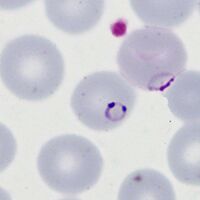
Accolé and double dot forms
-
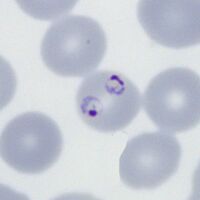
Multiple parasite form


"