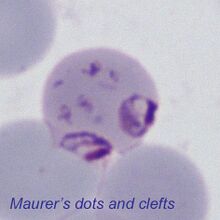
Added dots main PV
From MalariaETC
| Navigation |
| >Previous Page |
| Cytoplasmic dots
The dots seen in the different malarial species are caused by parasite proteins that are used to modify red cell function in a range of ways to support their development, immune evasion or virulence. The precise functions of dots in different species is poorly understood, but their appearances have substantial value in distinguishing the different species of parasite. Schüffner's dots (P.vivax) and James' dots) (P.ovale) are very numerous red/purple dots that become apparent during the early trophozoite as faint dots, then more easily seen in later developmental stages. The dots are frequent evenly-distributed, round, and ave similar size. Maurer's dots and clefts (P.falciparum) are blue/purple coloured and are not acquired until the late trophozoite stage of parasite development, are fewer in number than Schüffner's or James' dots and may appear as dots, clefts or plaques. The Sinton and Mulligan's stippling of P.knowlesi may appear similar to Maurer's dots. Ziemann's stippling (P.malariae) Is not usually seen, but when present appears as faint fine (and inconspicuous) dots in cytoplasm of some infected erythrocytes. |