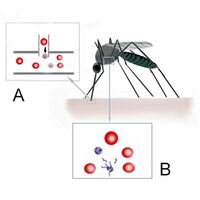
The final stage of the malaria lifecycle is the re-infection of a mosquito that bites an infected host. This still has some relevance to diagnosis under particular circumstances.
Explanation of correct answer (click "Expand")
Short answer taken from section "Gametocyte Biology" (see the section for full details and links).
A proportion of mature trophozoites give rise to the sexual gametocyte form, contained within ghost red cells (they have metabolised all haemoglobin in order to grow) - The red cell is therefore now simply a membrane that surrounds the parasite without any red colour, but generally retains any cytoplasmic dots typical of the species. Malaria pigment that represents the metabolised haem iron is prominent with different distributions that reflect the species. The appearance of gametocytes does vary according to species and this can aid morphological species identification with red cell appearances typical of the species, and (in the case of P.falciparum a distinctive straight or curved rod shape.
P.falciparum In this species the gametocytes have a "rod" shape which may be constricted by the remaining red cell membrane to form a curved shape (often described as banana-shaped).