RDT test: design and function
From MalariaETC
Navigation
Go back
Test formats vary, but share common principles - this is illustrated using a test for a single P.falciparum parasite antigen below.
| TEST PROCESS |
The buffer introduced through the lower window (A); this contains lysing agents. The blood sample loaded into a second window (B) meets the buffer and the lysis of red cells will release and breakdown any malarial parasites they contain. These lysed red cells and any parasite proteins then diffuse along the strip where they encounter labelled anti-malarial antibody (Ab). After encountering the antibody the lysate continues to migrate along the strip driven by excess buffer (blue arrow).
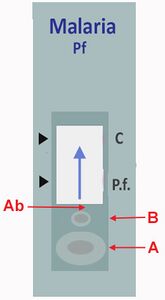
The process is shown in more detail below: buffer (A) and blood sample (B) enter the strip where red cells and parasites are lysed. The lysed red cells and any parasite antigens then encounter the labelled antibody (Ab). If malaria antigens are present these labelled antibodies bind to the malarial proteins to form labelled immune-complexes (as shown in the window on the iamge).

The lysed red cell preparation containing free-labelled antibody and any labelled-immune-complexes then migrate along the strip (red arrow) pushed by the remaining buffer (blue arrow). If the test has been performed correctly the lysed red cells will migrate to the end of the strip. During this process they will first pass over a test line (T) then a control areas (C) (see below).

| "POSITIVE" test result |
If dye-labelled malaria-antigen/antibody complex is present this diffuses along the strip until it encounters an immobilised parasite-specific antibody on the strip. This immobilised antibody “captures” the labelled antibody/antigen complex forming a visible line (a positive test line T). The remaining sample containing labelled antibody that has not bound antigen continues to diffuse along the strip encountering a further immobilised antibody that captures antibodies that have not bound antigen forming a control line (C) which indicates that test has been successfully performed.

For this simple test format detecting P.falciparum only, a positive result appears on the test as two visible lines (P.f and C). Shown below.

| "NEGATIVE" test result |
If dye-labelled malaria-antigen/antibody complex is not present then nothing will be captured by the malaria-specific test line (T). However, the sample containing labelled antibody that has not bound antigen will still bind to the immobilised antibody that forms control line (C) showing that the test has been successfully performed.


(2) Where the parasite-antigen is present, the dye-labelled antibody will bind to that antigen to form a complex (binding=B). This dye-labelled antigen/antibody complex then diffuses along the strip until it encounters a second parasite-specific antibody immobilised as a band on the strip. This immobilised antibody “captures” the labelled antibody/antigen complex to form a visible line (capture 1 = C).
(3) The remaining lysed sample (containing labelled antibody not bound to parasite antigen) continues to diffuse along the strip. And encounters a further immobilised antibody that captures it. This forms a control line which indicates that test has been successfully performed (capture 2 = D).