Species identification: summary page: Difference between revisions
From MalariaETC
No edit summary |
No edit summary |
||
| Line 61: | Line 61: | ||
<div style="width: 95%"> | <div style="width: 95%"> | ||
{| class="wikitable" style="border-style: solid; border-width: 4px; border-color:gray; color:black" | {| class="wikitable" style="border-style: solid; border-width: 4px; border-color:gray; color:black" | ||
|colspan="1" style = "font-size:100%; color:black; background: #afbddb |'''''Plasmodium | |colspan="1" style = "font-size:100%; color:black; background: #afbddb |'''''Plasmodium ovale''''' | ||
|} | |} | ||
</br> | </br> | ||
| Line 70: | Line 70: | ||
File:POGc.jpg|<span style="font-size:80%">Gametocyte</span>|link={{filepath:POGc.jpg}} | File:POGc.jpg|<span style="font-size:80%">Gametocyte</span>|link={{filepath:POGc.jpg}} | ||
</gallery> | </gallery> | ||
</br> | |||
<span style="font-size:90%">'''Summary: ''' Trophozites tend to retain a ring appearance but are large and robust. Red cells become moderately enlarged and may have oval shape and/or characteristic fimbriation. Expect James' dots to be easily seen in appropriately stained samples. Cases may be difficult to distinguish morphologically from ''P.vivax''.</span> | |||
</br> | |||
<span style="font-size:200%">'''→'''</span> [[Plasmodium ovale: Morphology|<span style="font-size:90%">'''CLICK''' for detailed description</span>]]'' | |||
</br></br> | |||
---- | |||
<div style="width: 95%"> | |||
{| class="wikitable" style="border-style: solid; border-width: 4px; border-color:gray; color:black" | |||
|colspan="1" style = "font-size:100%; color:black; background: #afbddb |'''''Plasmodium malariae''''' | |||
|} | |||
</br> | |||
<gallery mode="nolines" widths=140px heights=140px> | <gallery mode="nolines" widths=140px heights=140px> | ||
File:PMETc.jpg|<span style="font-size:80%">''Early trophozoite''</span>|link={{filepath:PMETc.jpg}} | File:PMETc.jpg|<span style="font-size:80%">''Early trophozoite''</span>|link={{filepath:PMETc.jpg}} | ||
Revision as of 09:25, 23 December 2024
| Navigation |
| >Main malaria Index |
| Plasmodium falciparum |
-

Early trophozoite
-

Late trophozoite
-
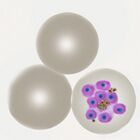
Schizont (rare)
-

Gametocyte


Summary: The ring trophozoites are small and fine with typical accolé forms, multiple parasites per cell, and double dot forms. Red cells aquire characteristic Maurer's dots and clefts in late trophozoites. Schizonts are rarely seen in blood, while gametocytes have are characteristicaly elongated (often curved).
→ CLICK for detailed description
| Plasmodium vivax |
-
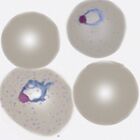
Early trophozoite
-

Late trophozoite
-

Schizont (rare)
-

Gametocyte


Summary: Large and robust rings may become "amoeboid" in shape during later development. The red cells become increasingly enlarged and distorted and Schüffner's dots are increasingly visible in cytoplams. All forms tend to circulate with large schizont and gametocyte forms present.
→ CLICK for detailed description
| Plasmodium ovale |
-

Early trophozoite
-

Late trophozoite
-
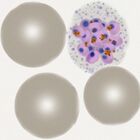
Schizont (rare)
-

Gametocyte


Summary: Trophozites tend to retain a ring appearance but are large and robust. Red cells become moderately enlarged and may have oval shape and/or characteristic fimbriation. Expect James' dots to be easily seen in appropriately stained samples. Cases may be difficult to distinguish morphologically from P.vivax.
→ CLICK for detailed description
| Plasmodium ovale |
-
Early trophozoite
-
Late trophozoite
-
Schizont (rare)
-
Gametocyte
Summary: Trophozites tend to retain a ring appearance but are large and robust. Red cells become moderately enlarged and may have oval shape and/or characteristic fimbriation. Expect James' dots to be easily seen in appropriately stained samples. Cases may be difficult to distinguish morphologically from P.vivax.
→ CLICK for detailed description
| Plasmodium malariae |
-

Early trophozoite
-

Late trophozoite
-

Schizont (rare)
-

Gametocyte


Summary: The species has small ring forms that are less delicate than P.falciparum and which becoming elongated or solid as parasites mature. Red cells are often small retaining their round shape most often with no added dots. Parasite number is often low, but all forms tend to circulate. Look for the characteristic "daisy" schizonts and small round gametocytes
| Plasmodium knowlesi |
-

Early trophozoite
-
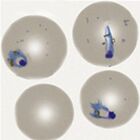
Late trophozoite
-

Schizont (rare)
-

Gametocyte


Brief Summary
- Very limited geographical distribution within S.E Asia
- Small fine ring forms resemble those of P.falciparum and may have high parasite count
- Later rings are more solid or elongated similar to P.malariae, although faint dots may be present
- Schizonts & gametocytes are often present and may resemble P.malariae but are less "neat"
- Characteristically red cell size is unaffected, although distortion may be seen