Multiple parasites: Difference between revisions
From MalariaETC
No edit summary |
No edit summary |
||
| Line 1: | Line 1: | ||
{{DISPLAYTITLE:<span style="position: absolute; clip: rect(1px 1px 1px 1px); clip: rect(1px, 1px, 1px, 1px);">{{FULLPAGENAME}}</span>}} | {{DISPLAYTITLE:<span style="position: absolute; clip: rect(1px 1px 1px 1px); clip: rect(1px, 1px, 1px, 1px);">{{FULLPAGENAME}}</span>}} | ||
---- | ---- | ||
<span style="font-size: | {| class="wikitable" style="width: 60%; border-style: none; border-width: 0px; border-color: gainsboro; color:black" | ||
|style = "font-size:110%; color:black; background: gainsboro |'''Navigation'''</br> | |||
|- | |||
|<span style="font-size:110%">>[[Plasmodium_falciparum:_Morphology|Previous Page]]''</span></br> | |||
|- | |||
|} | |||
---- | ---- | ||
<span style="font-size:90%>In some cases more than one parasite (most often though not always early or late trophozoites) infect a single erythrocyte. This is a surprisingly frequent finding, and it has been suggested some red cells are more attractive to parasites, or that already infected cells are more susceptible.</span> | <span style="font-size:90%>In some cases more than one parasite (most often though not always early or late trophozoites) infect a single erythrocyte. This is a surprisingly frequent finding, and it has been suggested some red cells are more attractive to parasites, or that already infected cells are more susceptible.</span> | ||
Revision as of 11:33, 10 December 2024
| Navigation |
| >Previous Page |
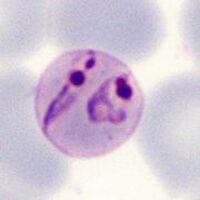
In some cases more than one parasite (most often though not always early or late trophozoites) infect a single erythrocyte. This is a surprisingly frequent finding, and it has been suggested some red cells are more attractive to parasites, or that already infected cells are more susceptible.

The most frequent form - two early trophozoites of P.falciparum in a single erythrocyte
Species significance
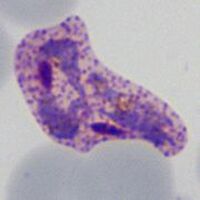
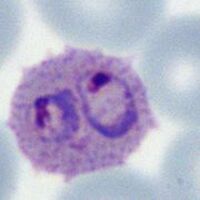
This is most often considered a feature indicating P.falciparum infection and is sufficiently frequent in that species to support the diagnosis of P.falciparum malaria. However, it should not considered as a fully specific feature, and may occur in any malaria species - and particularly in P.knowlesi (this is also a frequent finding for babesia parasites).
Additional images
-
A
-
B
-
C


Double parasites in: late trophozoite of P.malaria (A) late trophozoite of P.vivax (B) and late trophozoite of P.ovale (C)