Gallery of gametocytes: Difference between revisions
From MalariaETC
No edit summary |
No edit summary |
||
| Line 22: | Line 22: | ||
<gallery mode="nolines" heights=200px widths=200px> | <gallery mode="nolines" heights=200px widths=200px> | ||
File:PVG1.jpg|<span style="font-size:80%"> | File:PVG1.jpg|<span style="font-size:80%">A large and irregular macrogmetocyte</span>|link={{filepath:PVG1.jpg}} | ||
File:PVG2.jpg|<span style="font-size:80%"> | File:PVG2.jpg|<span style="font-size:80%">Large macrogametocyte fills red cell</span>|link={{filepath:PVG2.jpg}} | ||
File:PVG3.jpg|<span style="font-size:80%">Microgametocytes with Schüffner's dots visible in red cell cytoplasm</span>|link={{filepath:PVG3.jpg}} | File:PVG3.jpg|<span style="font-size:80%">Microgametocytes with Schüffner's dots visible in red cell cytoplasm</span>|link={{filepath:PVG3.jpg}} | ||
</gallery>" | </gallery>" | ||
---- | ---- | ||
<span style="font-size:90%">''' ''P.ovale'' '''</span></br> | <span style="font-size:90%">''' ''P.ovale'' '''</span></br> | ||
<span style="font-size:90%"> | <span style="font-size:90%">Similar to ''P.vivax'' but generally smaller and the red cell will often show features such as James' dots, fimbriation and ovoid shape. Pigment tends to be around the circumference of the parasite. | ||
<gallery mode="nolines" heights=200px widths=200px> | <gallery mode="nolines" heights=200px widths=200px> | ||
File:POG1.jpg|<span style="font-size:80%"> | File:POG1.jpg|<span style="font-size:80%">Elongated and ovoid red cell contains the parasite </span>|link={{filepath:POG1.jpg}} | ||
File:POG2.jpg|<span style="font-size:80%"> | File:POG2.jpg|<span style="font-size:80%">Small round parasite with prominent James' dots</span>|link={{filepath:POG2.jpg}} | ||
File:POG4.jpg|<span style="font-size:80%"> | File:POG4.jpg|<span style="font-size:80%">A more typically ovoid form</span>|link={{filepath:POG4.jpg}} | ||
File:POG5.jpg|<span style="font-size:80%"> | File:POG5.jpg|<span style="font-size:80%">Round parasite note the pigment around the circumference</span>|link={{filepath:POG5.jpg}}</gallery>" | ||
---- | ---- | ||
<span style="font-size:90%">''' ''P.malariae'' '''</span></br> | <span style="font-size:90%">''' ''P.malariae'' '''</span></br> | ||
Revision as of 13:51, 2 December 2024
Navigation
>Main Malaria Index
>>Galleries Index Page
>>>Current page: Gallery of gametocytes
Gallery of Gametocytes
Gametocytes essentially have "microgametocyte" (male) or "macrogametocyte" (female) appearance. For most species the gametocyte is round or slightly angular with species differences mainly reflected in the size of the red cell or parasite, although red cell dots may be seen in P.vivax or P.ovale. The exception is the P.falciparum parasite that has an elongated rod form that may become curved by the residual erythroid membrane - sometimes called the "banana" form..
P.falciparum
Rod shaped gametocytes may be straingh and blunt (mainly the shorter "microgametocytes") or curved by the red cell membrane producing a curved and more pointed end (banana form). Pigment generally overlies the central chromatin area.
-

Macrogametocyte, curved by the red cell membrane
-

Microgametocytes, a blunt rod, red cell membrane is "floppy"
-

A more sharp-ended curved macrogametocyte


"
P.vivax
As with other forms in this species parasites and infected red cells are characteristically large; Schüffner's may be seen or hidden by the parasite for macrogametocyte forms. Parasites may have an irregular shape; pigment distribution is diffuse. Images show a maturing sequence.
-

A large and irregular macrogmetocyte
-
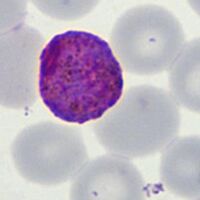
Large macrogametocyte fills red cell
-

Microgametocytes with Schüffner's dots visible in red cell cytoplasm


"
P.ovale
Similar to P.vivax but generally smaller and the red cell will often show features such as James' dots, fimbriation and ovoid shape. Pigment tends to be around the circumference of the parasite.
-

Elongated and ovoid red cell contains the parasite
-
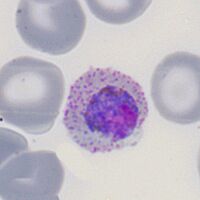
Small round parasite with prominent James' dots
-

A more typically ovoid form
-
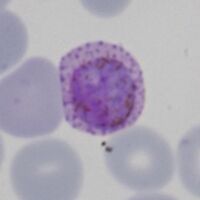
Round parasite note the pigment around the circumference


"
P.malariae
Small and often neat parasites with few merozoites when mature (generally around 8). Often there is a central clump of pigment with merozoites arranged around this (daisy head appearance).
-

Early schizont with multiple chromatin dots
-
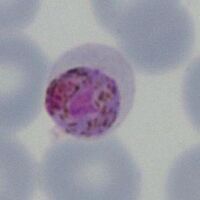
A daisy with merozoites around central pigment
-

A less well formed daisy, note small size
-

Late form prior to merozoite release


"
P.knowlesi
Similar in appearance to P.malariae. The forms tend to be small with relatively few merozoites present. Pigment tend to form a clump.
-

Early form with few chromatin masses
-

Almost a daisy with central clumped pigment

