Gallery of schizonts: Difference between revisions
From MalariaETC
No edit summary |
No edit summary |
||
| Line 30: | Line 30: | ||
---- | ---- | ||
<span style="font-size:90%">''' ''P.ovale'' '''</span></br> | <span style="font-size:90%">''' ''P.ovale'' '''</span></br> | ||
<span style="font-size:90%">Share many features with ''P.vivax'' and may not be easy to distinguish, tend not to be as large with up to 16 | <span style="font-size:90%">Share many features with ''P.vivax'' and may not be easy to distinguish, tend not to be as large with fewer merozoites (up to 16). Ovoid shape and fimbriation of red cells may be present together with James' dots. Pigment has a patchy distribution. | ||
<gallery mode="nolines" heights=200px widths=200px> | <gallery mode="nolines" heights=200px widths=200px> | ||
File:POS1.jpg|<span style="font-size:80%"> | File:POS1.jpg|<span style="font-size:80%">Early small form note James' dots</span>|link={{filepath:POS1.jpg}} | ||
File:POS3.jpg|<span style="font-size:80%"> | File:POS3.jpg|<span style="font-size:80%">Early form, merozoites still form a single mass</span>|link={{filepath:POS3.jpg}} | ||
File:POS2.jpg|<span style="font-size:80%"> | File:POS2.jpg|<span style="font-size:80%">Small mature form with separated merozoites</span>|link={{filepath:POS2.jpg}} | ||
File:POS4.jpg|<span style="font-size:80%"> | File:POS4.jpg|<span style="font-size:80%">Mature larger form, note ovoid shape</span>|link={{filepath:POS4.jpg}}</gallery>" | ||
---- | ---- | ||
<span style="font-size:90%">''' ''P.malariae'' '''</span></br> | <span style="font-size:90%">''' ''P.malariae'' '''</span></br> | ||
Revision as of 13:29, 29 November 2024
Navigation
>Main Malaria Index
>>Galleries Index Page
>>>Current page: Gallery of schizonts
Gallery of Schizonts
Schizont morphology is variable as they progress from late trophoxoites, dividing their chromatin into seprate distict masses (usually a schizont is defined by have more than two masses to distinguish them from rings with double dots). The morphological variability then continues as the merozoites separate before release. However, despite this, some features such as erythocyte size and shape, added dots, pigment distribution and the number of merozoites present can still be useful (as can the fact that they are rarely seen in P.falciparum.
P.falciparum
Loose and often "tatty" appearances with 8-16 merozoites and clumped pigment when mature. Rare in blood as they sequesterin tissues and circulating form may appear degenerate. Images show mature forms.
-
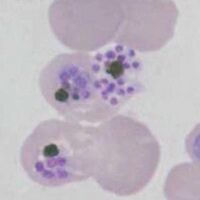
Variable merozoite number, clumped pigment
-
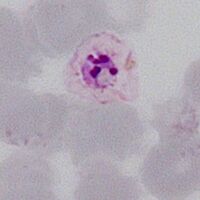
Degenerate small merozoite
-

Large merozoites
-
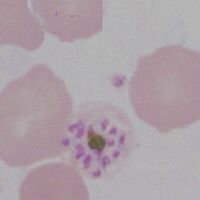
Large merozoites


"
P.vivax
Charactertically large and Schüffner's dots may be seen. The merozoites tend to pack the red cell with numbers up to 16-32 in mature merozoites. Pigment has diffuse distribution. Images show a maturing sequence.
-

Early form with separate chromatin but no individual merozoites
-

Similar to previous, note Schüffner's dots
-

Maturing form with separate merozoites
-

Large mature form


"
P.ovale
Share many features with P.vivax and may not be easy to distinguish, tend not to be as large with fewer merozoites (up to 16). Ovoid shape and fimbriation of red cells may be present together with James' dots. Pigment has a patchy distribution.
-
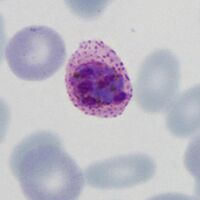
Early small form note James' dots
-

Early form, merozoites still form a single mass
-
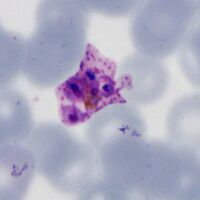
Small mature form with separated merozoites
-

Mature larger form, note ovoid shape


"
P.malariae
Small and often neat parasites with few merozoites when mature (generally around 8). Often there is a central clump of pigment with merozoites arranged around this (daisy head appearance).
-

Early elongated form, small red cell
-
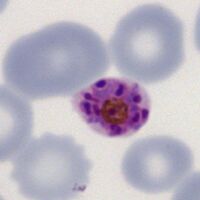
A full band across the red cells
-
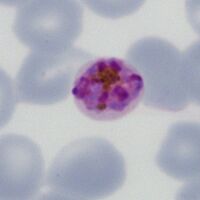
An open angular parasite, note pigment
-
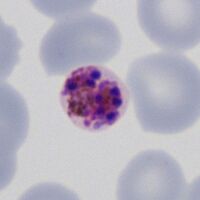
Angularity form


"
P.knowlesi
Similar in appearance to P.malariae. The forms tend to be small with relatively few merozoites present. Pigment tend to form a clump.
-

Mixed irregular rings sparse dots
-

Elongated parasite forms
-

Solid and angular forms
-

Mixed forms, dots and pigment


