RDT test: design and function: Difference between revisions
From MalariaETC
No edit summary |
No edit summary |
||
| Line 51: | Line 51: | ||
A positive test test result: | A positive test test result: | ||
<gallery mode="nolines" widths=350px heights=300px> | |||
File:3 RDT_work.jpg|<span style="font-size:90%"></span>|link={{filepath:3 RDT_work.jpg}} | |||
</gallery> | |||
<gallery mode="nolines" widths=200px heights=300px> | <gallery mode="nolines" widths=200px heights=300px> | ||
File:3_PF_RDT_pos.jpg|<span style="font-size:90%"></span>|link={{filepath:3_PF_RDT_pos.jpg}} | File:3_PF_RDT_pos.jpg|<span style="font-size:90%"></span>|link={{filepath:3_PF_RDT_pos.jpg}} | ||
</gallery> | </gallery> | ||
(2) Where the parasite-antigen is present, the dye-labelled antibody will bind to that antigen to form a complex (binding=B). This dye-labelled antigen/antibody complex then diffuses along the strip until it encounters a second parasite-specific antibody immobilised as a band on the strip. This immobilised antibody “captures” the labelled antibody/antigen complex to form a visible line (capture 1 = C).</br> | (2) Where the parasite-antigen is present, the dye-labelled antibody will bind to that antigen to form a complex (binding=B). This dye-labelled antigen/antibody complex then diffuses along the strip until it encounters a second parasite-specific antibody immobilised as a band on the strip. This immobilised antibody “captures” the labelled antibody/antigen complex to form a visible line (capture 1 = C).</br> | ||
(3) The remaining lysed sample (containing labelled antibody not bound to parasite antigen) continues to diffuse along the strip. And encounters a further immobilised antibody that captures it. This forms a control line which indicates that test has been successfully performed (capture 2 = D).</br> | (3) The remaining lysed sample (containing labelled antibody not bound to parasite antigen) continues to diffuse along the strip. And encounters a further immobilised antibody that captures it. This forms a control line which indicates that test has been successfully performed (capture 2 = D).</br> | ||
Revision as of 18:44, 26 June 2024
Navigation
Go back
| Basic Principle |
For a patient suspected to have malaria infection:
(1) A blood sample and lysing buffer are loaded to the test to release any parasite antigens
(2) These are then exposed to specific dye-labelled antibodies that recognise parasite proteins
(3) The labelled antibodies bind to any parasite proteins present to form lablelled antigen-antibody complexes.
(4) These complexes are then captured by a second antibody immoblised on a nitro-cellulase to form a visible band.
(5) A control line binds lablelled antibody that has not bound malaria antigen showing the test was correctly performed

A positive "single band" type malaria test.
| How the tests work |
Test formats vary, but share common principles - this is illustrated for a single parasite antigen below.
(1) In a typical test lysis buffer is loaded into one window (A), then the blood sample in a second window (B). Following this the lysed blood sample diffuses along the strip encontering lablelled antibody (Ab) then continues to diffuse into the window (pink arrow).
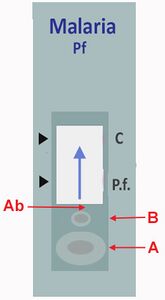
(2) The same process is shown below with buffer (A'), blood sample (B) encountering antibody (Ab') where any parasite antigen encounters antibody to form immune complexes (shown in the window)."

A positive test test result:


(2) Where the parasite-antigen is present, the dye-labelled antibody will bind to that antigen to form a complex (binding=B). This dye-labelled antigen/antibody complex then diffuses along the strip until it encounters a second parasite-specific antibody immobilised as a band on the strip. This immobilised antibody “captures” the labelled antibody/antigen complex to form a visible line (capture 1 = C).
(3) The remaining lysed sample (containing labelled antibody not bound to parasite antigen) continues to diffuse along the strip. And encounters a further immobilised antibody that captures it. This forms a control line which indicates that test has been successfully performed (capture 2 = D).