Alt menu: Difference between revisions
From MalariaETC
No edit summary |
No edit summary |
||
| Line 23: | Line 23: | ||
<span style="font-size:90%">Precise test formats can differ according to manufacturer and purpose, but follow similar principles using either a plastic cassette or a folding card.</span> | <span style="font-size:90%">Precise test formats can differ according to manufacturer and purpose, but follow similar principles using either a plastic cassette or a folding card.</span> | ||
<span style="font-size:90%">In addition to their control line (C), the tests may have a single test-band or have multiple test bands | <span style="font-size:90%">In addition to their control line (C), the tests may have a single test-band or have multiple test bands</span> | ||
<gallery mode="nolines" widths=300px heights=80px> | <gallery mode="nolines" widths=300px heights=80px> | ||
File:RDT_single.jpg|<span style="font-size:90%"></span>Single test | File:RDT_single.jpg|<span style="font-size:90%"></span>Single band test|link={{filepath:RDT_single.jpg}} | ||
File:RDT_multi.jpg|<span style="font-size:90%"></span>Multi test | File:RDT_multi.jpg|<span style="font-size:90%"></span>Multi-band test|link={{filepath:RDT_multi.jpg}} | ||
</gallery></br> | </gallery></br> | ||
</br> | |||
<span style="font-size:200%">→</span> [[RDT test: formats of tests|Click for more detail on test formats]] | <span style="font-size:200%">→</span> [[RDT test: formats of tests|Click for more detail on test formats]] | ||
</br> | </br> | ||
Revision as of 17:49, 19 September 2024
Navigation
Return to Main index
Alt menu
| OVERVIEW |
RDTs detect malarial parasite antigens in the blood of infected individuals. The simplest format (with a single test and control line) is shown below.

How do the tests work? Essentially, a lysis buffer is introduced to one window and a sample of blood into the second window. The interaction between buffer and sample breaks down the red cells and any malaria parasites present (lysis); this "lysed" sample then diffuses along the strip where it mixes with labelled-antibodies that detect the presence of parasites, ultimately these will a visible band in one or more test windows (T). Successful test performance will be shown by the appearance of a control band (C).
→ Click for more detail on how the tests work
| TEST FORMATS |
Precise test formats can differ according to manufacturer and purpose, but follow similar principles using either a plastic cassette or a folding card.
In addition to their control line (C), the tests may have a single test-band or have multiple test bands
-
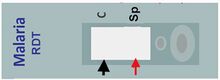
Single band test
-

Multi-band test


→ Click for more detail on test formats
| HOW EFFECTIVE ARE THEY? |
RDTs provide a rapid result to indicate the possible presence or absence of malaria infection. In some circumstances they may be the only easily available test for malaria. However, RDT tests should never be considered a "gold standard"
The table below provides a summary of likely sensitivity for RDT tests when suitable species-specific together with pan-malarial antibodies are used
| P.falciparum1 |
|---|
| At high parasitaemia expect high sensitivity (90-95%). This declines when parasite levels are lower (45-70%)2 |
| P.vivax |
| Expect moderate to high sensitivity at high parasitaemia (70-90%). This declines markedly when parasite levels are lower (30-60%)2 |
| P.ovale & P.malarae |
| Generally sensitivity is poor (approximately half the sensitivity shown for P.vivax) |
| P.knowlesi3 |
| Reports suggest variable sensitivity that may depend on test used, RDTs are reported tp detect this species well when parasitaemia is high. |
Notes:
1 HRP2 mutation mean that in some geographical areas the diagnostic sensitivity may be significantly lower (see below)
2 Low parasite number is considered as (<1000 parasites/μL) a level that may cause symptoms in children or non-immune travellers
3 There have been relatively few studies with this species so caution is required in RDT interpretation
Tests from different manufacturers recognise different malarial antigens. You should be aware of benefits or drawbacks of the antigens used in your test.
→ Click for more detail on the antigens they detect
| INTERPRETATION |
The possible patterns seen on RDT tests are relatively simple, and in most cases the most probable diagnosis is clear. However, there may be alternative interpretations of band patters. The guides below are for the most common test formats, and most frequent band patters. iF your test differs then you may need to be adapt this advice.
See Guides below for common test patterns:
Interpretation guide: SINGLE BAND tests
Interpretation guide: MULTI BAND tests