Gallery of late trophozoites: Difference between revisions
From MalariaETC
No edit summary |
No edit summary |
||
| Line 9: | Line 9: | ||
<span style="font-size:120%; color:navy">Gallery of Late Trophozoites</br></span> | <span style="font-size:120%; color:navy">Gallery of Late Trophozoites</br></span> | ||
</br> | </br> | ||
<span style="font-size:90%"> | <span style="font-size:90%">Late trophozoites often have "species-specific" changes that affect parasite, red cell shape or added dots. These may be very helpful in assigning diagnosis, although not all changes are fully specific to a single species.</br></br> | ||
---- | ---- | ||
<span style="font-size:90%">''' ''P.falciparum'' '''</span></br> | <span style="font-size:90%">''' ''P.falciparum'' '''</span></br> | ||
Revision as of 13:07, 28 November 2024
Navigation
>Main Malaria Index
>>Galleries Index Page
>>>Current page: Gallery of late trophozoites
Gallery of Late Trophozoites
Late trophozoites often have "species-specific" changes that affect parasite, red cell shape or added dots. These may be very helpful in assigning diagnosis, although not all changes are fully specific to a single species.
P.falciparum
Small delicate rings, and these may be the only forms seen in some patients at diagnosis. Infected red cells have normal (or slightly crenated) appearance.
-

Fine ring form
-

Double dot form and normal ring
-
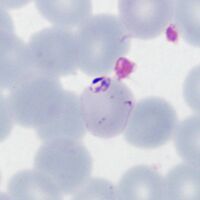
Accolé and double dot forms
-

Multiple parasite form


"
P.vivax
Rings begin as small forms, but become larger asociated with enlarged distorted red cells as they develop. Schüffner's dots will become present
-
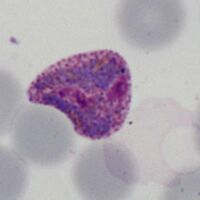
Early ring form
-
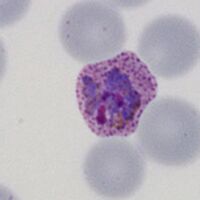
Early ring form with faint dots
-

Llarge thickened ring trophozoite
-

Ring trophozoites, Schüffner's dots


"
P.ovale
Ring form is retained but enlarges, red cells may develop fimbriation and enlarged ovoid form with visible James' dots.
-

Early ring form
-

Ring with dots/fimbriation
-
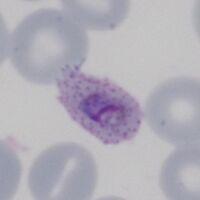
faint Ziemann's dots
-

Ring early ovoid change


"
P.malariae
Infected red cells are generally infrequent. Early trophozoites are small in normal or small erythrocytes, and may have central chromatin dot, elongation or angular forms.
-
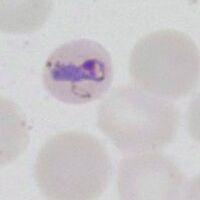
Ring form in small red cell
-

The central chromatin dot
-
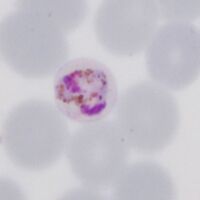
Early elongation, Stinton's dots
-
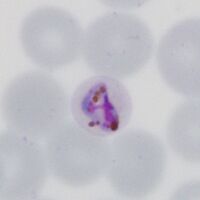
Early angularity of form


"
P.knowlesi
The early trophozoite may resembles P.falciparum and infected cells may be frequent. Later forms however begin to resemble parasites of P.malariae.
-

Fine early rings
-

Double dot (right)
-

Accolé form
-

Multiple infection


