Cytoplasmic dots: Difference between revisions
From MalariaETC
No edit summary |
No edit summary |
||
| Line 10: | Line 10: | ||
{| class="wikitable" style="widthe:90%; border-style: solid; border-width: 4px; border-color:teal" | {| class="wikitable" style="widthe:90%; border-style: solid; border-width: 4px; border-color:teal" | ||
|colspan="1" style = "font-size:140%; color:black; background: FFFAFA"|<span style="color:black>'''Cytoplasmic dots'''</span> | |colspan="1" style = "font-size:140%; color:black; background: FFFAFA"|<span style="color:black>'''Cytoplasmic dots'''</span> | ||
---- | |||
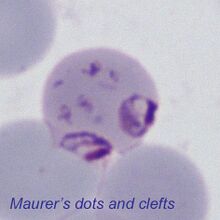
The dots of different species represent parasite proteins that modify red cell function in a range of ways to support parasite development, immun evasion or virulence. Their precise functions are ill defined, but their appearances have value in distinguishing the different species of parasite. | |||
---- | ---- | ||
<gallery mode="nolines" widths="220px" heights="220px" > | <gallery mode="nolines" widths="220px" heights="220px" > | ||
Revision as of 14:04, 15 November 2024
Navigation
>Main Malaria Index
>>Malaria Biology Index
>>>Biology of the trophozoite
>>>Current page: Cytoplasmic dots
| Cytoplasmic dots
The dots of different species represent parasite proteins that modify red cell function in a range of ways to support parasite development, immun evasion or virulence. Their precise functions are ill defined, but their appearances have value in distinguishing the different species of parasite. |