Biology Quiz A Q5: Difference between revisions
From MalariaETC
(Created page with "{{DISPLAYTITLE:<span style="position: absolute; clip: rect(1px 1px 1px 1px); clip: rect(1px, 1px, 1px, 1px);">{{FULLPAGENAME}}</span>}} ---- <span style="font-size:90%">Go to Previous Question</span></br> {| class="wikitable" style="width:100%; border-style: solid; border-width: 2px; border-color:teal" |colspan="1" style = "font-size:130%; color:black; background: FFFAFA"|<span style="color:black>'''Biology Quiz A Q5'''</span> </br><span style="font...") |
No edit summary |
||
| (10 intermediate revisions by the same user not shown) | |||
| Line 4: | Line 4: | ||
{| class="wikitable" style="width:100%; border-style: solid; border-width: 2px; border-color:teal" | {| class="wikitable" style="width:100%; border-style: solid; border-width: 2px; border-color:teal" | ||
|colspan="1" style = "font-size:130%; color:black; background: FFFAFA"|<span style="color:black>'''Biology Quiz A Q5'''</span> | |colspan="1" style = "font-size:130%; color:black; background: FFFAFA"|<span style="color:black>'''Biology Quiz A Q5'''</span> | ||
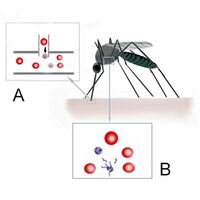
</br><span style="font-size:90%"> | </br><span style="font-size:90%">The final stage of the malaria lifecycle is the re-infection of a mosquito that bites an infected host. This still has some relevance to diagnosis under particular circumstances.</span></br></br> | ||
<gallery mode="nolines" widths=200px heights=250px> | <gallery mode="nolines" widths=200px heights=250px> | ||
File:Mosquito uptake | File:Mosquito uptake.jpg|link={{filepath:Mosquito uptake.jpg.jpg}} | ||
</gallery> | </gallery> | ||
<quiz display=simple> | <quiz display=simple> | ||
| Line 12: | Line 12: | ||
{<span style="font-size:90%">Concerning gametocytes which statements are correct? ('''select all true statements''')</br></br> | {<span style="font-size:90%">Concerning gametocytes which statements are correct? ('''select all true statements''')</br></br> | ||
|type="[]"} | |type="[]"} | ||
- <span style="font-size:90%"> | - <span style="font-size:90%">Schizonts mediate infection of mosquitos | ||
+ <span style="font-size:90%"> | + <span style="font-size:90%">Sexual replication activates at low pH | ||
+ <span style="font-size:90%">Microgametocytes undergo exflagellation | |||
+ <span style="font-size:90%">Exflagellation may be seen in stored blood | |||
+ <span style="font-size:90%">Macrogametocytes aggregate in stored blood | |||
</quiz> | </quiz> | ||
| Line 22: | Line 22: | ||
! colspan="1" | Explanation of correct answer (click "Expand") | ! colspan="1" | Explanation of correct answer (click "Expand") | ||
|- | |- | ||
|<span style="font-size:90%">''Short answer taken from section " | |<span style="font-size:90%">''Short answer taken from section "Re-infection of the mosquito" (see the section for full details and links).</br></br>''<span style="font-size:90%">When a mosquito feeds from a malaria infected host, the blood meal will contain parasites of all forms. Importantly these forms include male and female gametocytes. The pH and temperature changes with the mosquito midgut cause the gametocytes to gain full sexual maturity (gametogenesis). The male gametocyte then undergoes 3 cycles of division to generate 8 male sexual forms (gametes). These then 8 gametes then "break out" of the male microgametocytes in a process known as exflagellation, and fuse with the female oocyte (derived from the macrogametocyte). Then following successful fusion move to the next stage of development with the mosquito gut wall. Finally the parasite enter the salivary glands of the mosquito as sporozoites where a new infection can be initiated.</br></br>If samples of blood undergo delayed spreading then the changes to pH and temperature caused by storage may partly mimic the conditions within the mosquito midgut leading to changes that would only normally be seen in the mosquito. Some may be difficult to recognise but are clearly atypical in appearance, others such as "exflagellation" have very clear appearances. It is important to be able to recognise these forms as they can cause confusion and misdiagnosis: The initial stage involves both the male microgametocytes and female macrogametocytes swelling and becoming more globular (these often clump together). The following stages are quite recognisable for the male gametocte as the male gametes burst from the erythrocytes in the process of exflagellation.</span></br> | ||
|} | |} | ||
{| class="wikitable" style="width:300px; border-left:solid 4px navy;border-right:solid 4px navy;border-top:solid 4px navy;border-bottom:solid 4px navy; font-size: | {| class="wikitable" style="width:300px; border-left:solid 4px navy;border-right:solid 4px navy;border-top:solid 4px navy;border-bottom:solid 4px navy; font-size:90%; color:navy; align:center" | ||
|colspan="1" style = "font-size:90%; color:black|<span style="color:black>[[ | |colspan="1" style = "font-size:90%; color:black|<span style="color:black>[[Biology_Quiz_Summary|NEXT PAGE]]</span> | ||
Latest revision as of 09:55, 21 March 2025
| Biology Quiz A Q5
|