Altered red cell size and shape: Difference between revisions
From MalariaETC
(Created page with "{| class="wikitable" style="border-style: solid; border-width: 4px; color:black" |colspan="1" style = "font-size:100%; color:black; background: FFFAFA"|<span style="color:navy>'''How is red cell size and shape affected as malaria develops?'''</span> During parasite develop, each species alters the red cell that they occupy. These changes differ between species causing characteristic changes to.red. cell size and red cell shape. These changes occur from a relatively ear...") |
No edit summary |
||
| (14 intermediate revisions by the same user not shown) | |||
| Line 1: | Line 1: | ||
{ | {{DISPLAYTITLE:<span style="position: absolute; clip: rect(1px 1px 1px 1px); clip: rect(1px, 1px, 1px, 1px);">{{FULLPAGENAME}}</span>}} | ||
'''Navigation'''</br> | |||
<span style="font-size:90%">>[[MalariaETC_Index|Main Malaria Index]]''</span></br> | |||
<span style="font-size:90%">>>[[Malaria_Biology|Malaria Biology Index]]''</span></br> | |||
<span style="font-size:90%">>>>[[Biology of the trophozoite stage|Biology of the trophozoite]]</span></br> | |||
<span style="font-size:90%">>>>Current page: ''Red cell size and shape'''</span> | |||
---- | |||
{| class="wikitable" style="widthe:90%; border-style: solid; border-width: 4px; border-color:teal" | |||
|colspan="1" style = "font-size:140%; color:black; background: FFFAFA"|<span style="color:black>'''Red cell size and shape'''</span> | |||
---- | ---- | ||
<span style="font-size:90%">During parasite development, each species alters the red cell that they occupy. These changes differ between species causing characteristic changes to cell size and red cell shape. These changes occur from a relatively early stage of parasite development although the very earliest trophozoites may yet show these features</span> | |||
---- | |||
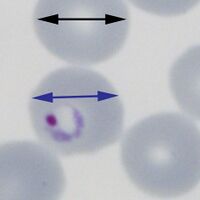
The red cells in this species remain round and are often small in size | <span style="font-size:90%">'''SMALL ROUND RED CELLS'''</br></br>''P.malariae''</br>The red cells in this species remain round and are often small in size</span> | ||
<gallery mode="nolines" widths="200px" heights="220px" > | <gallery mode="nolines" widths="200px" heights="220px" > | ||
| Line 18: | Line 23: | ||
</gallery> | </gallery> | ||
The early (A) and late trophozoites (B) shown in this image each lie within round erythrocytes with reduced size. | <span style="font-size:90%">The early (A) and late trophozoites (B) shown in this image each lie within round erythrocytes with reduced size.</span> | ||
---- | ---- | ||
'''RED CELLS WITH UNCHANGED SIZE AND SHAPE''' | <span style="font-size:90%">'''RED CELLS WITH UNCHANGED SIZE AND SHAPE'''</br></br>Size and shape of red cells tends to be unchanged in trphozoites of ''P.falciparum'' and ''P.knowlesi''.although in ''P.falciparum'' red cells may become crenated</span> | ||
''P.falciparum'' | |||
<gallery mode="nolines" widths="200px" heights="220px" > | <gallery mode="nolines" widths="200px" heights="220px" > | ||
File:3SizePMET.jpg|A|link={{filepath:|3SizePMET.jpg}} | File:3SizePMET.jpg|A|link={{filepath:|3SizePMET.jpg}} | ||
File:4SizePFLT.jpg|B|link={{filepath:4SizePFLT.jpg}} | File:4SizePFLT.jpg|B|link={{filepath:4SizePFLT.jpg}} | ||
</gallery> | |||
<gallery mode="nolines" widths="200px" heights="220px" > | |||
File:0SizePKET.jpg|B|link={{filepath:0SizePKET.jpg}} | |||
File:0SizePKLT.jpg|B|link={{filepath:0SizePKLT.jpg}} | |||
</gallery> | </gallery> | ||
The early (A) | <span style="font-size:90%">The early trophozoites (A) lie within red cells that are not changed size or shape, at later development stages (B) size and shape remain unchanged or acquire subtle crenation.</br> | ||
---- | ---- | ||
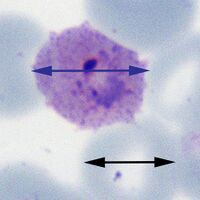
'''ENLARGED AND DISTORTED RED CELLS''' | <span style="font-size:90%">'''ENLARGED AND DISTORTED RED CELLS'''</br></br>For both ''P.ovale'' and ''P.vivax'' the red cells become progressively enlarged and distorted as the parasites develop. It may not be possible to distingish the species based on red cell appearances, but there are differences which should be looked for.</br></br>''P.ovale''</br>Expect increased red cell size but this may not be marked; the typical shape is an ovoid shape (hence the name) and there may be characteristic fimbriation of cytoplasm (that may be limited to one pole of the cell).</span> | ||
For both ''P.ovale'' and ''P.vivax'' the red cells become progressively enlarged and distorted as the parasites develop. It may not be possible to distingish the species based on red cell appearances, but there are differences which should be looked for. | |||
''P.ovale'' | |||
Expect increased red cell size but this may not be marked; the typical shape is an ovoid shape (hence the name) and there may be characteristic | |||
<gallery mode="nolines" widths="200px" heights="220px" > | <gallery mode="nolines" widths="200px" heights="220px" > | ||
File:5SizePOET.jpg|A|link={{filepath:|5SizePOET.jpg}} | File:5SizePOET.jpg|A|link={{filepath:|5SizePOET.jpg}} | ||
| Line 53: | Line 49: | ||
</gallery> | </gallery> | ||
Early (A) and late (B) trophozoites | <span style="font-size:90%">Early (A) and late (B) trophozoites of ''P.ovale''. In each case there is a tendency for red cells to have an ovoid shape and there is distortion of the cytoplasm with sharp projectiosn (fimbriation). These irregular and spiky projections differ from the rounded crenation that may be seen in ''P.falciparum''.</span> | ||
- | <span style="font-size:90%">''P.vivax''</br>This species tend to have the largest red cell size that becomes evident at quite and early stage; the typical shape is quite irregular fimbriation is not (generally) seen.</span> | ||
''P.vivax'' | |||
This species tend to have the largest red cell size that becomes evident at quite and early stage; the typical shape is quite irregular fimbriation is not (generally) seen. | |||
<gallery mode="nolines" widths="200px" heights="220px" > | <gallery mode="nolines" widths="200px" heights="220px" > | ||
| Line 66: | Line 59: | ||
</gallery> | </gallery> | ||
Early and trophozoites of ''P.vivax''. The increased size and red cell distortion increase as the parasites mature. In this case the early trophozoite (A) is enlarged but still retains a relatively undistorted elongated shape (similar to ''P.ovale''); however the late form (B) is has a very irregular shape (note there is no fimbriation). | <span style="font-size:90%">Early and trophozoites of ''P.vivax''. The increased size and red cell distortion increase as the parasites mature. In this case the early trophozoite (A) is enlarged but still retains a relatively undistorted elongated shape (similar to ''P.ovale''); however the late form (B) is has a very irregular shape (note there is no fimbriation).</span> | ||
Latest revision as of 22:23, 16 March 2025
Navigation
>Main Malaria Index
>>Malaria Biology Index
>>>Biology of the trophozoite
>>>Current page: Red cell size and shape'
| Red cell size and shape
During parasite development, each species alters the red cell that they occupy. These changes differ between species causing characteristic changes to cell size and red cell shape. These changes occur from a relatively early stage of parasite development although the very earliest trophozoites may yet show these features SMALL ROUND RED CELLS
The early (A) and late trophozoites (B) shown in this image each lie within round erythrocytes with reduced size.
RED CELLS WITH UNCHANGED SIZE AND SHAPE
The early trophozoites (A) lie within red cells that are not changed size or shape, at later development stages (B) size and shape remain unchanged or acquire subtle crenation.
ENLARGED AND DISTORTED RED CELLS
Early (A) and late (B) trophozoites of P.ovale. In each case there is a tendency for red cells to have an ovoid shape and there is distortion of the cytoplasm with sharp projectiosn (fimbriation). These irregular and spiky projections differ from the rounded crenation that may be seen in P.falciparum.
Early and trophozoites of P.vivax. The increased size and red cell distortion increase as the parasites mature. In this case the early trophozoite (A) is enlarged but still retains a relatively undistorted elongated shape (similar to P.ovale); however the late form (B) is has a very irregular shape (note there is no fimbriation). |