P.falciparum late trophozoites gallery: Difference between revisions
From MalariaETC
No edit summary |
No edit summary |
||
| (One intermediate revision by the same user not shown) | |||
| Line 7: | Line 7: | ||
|} | |} | ||
<span style="font-size:90%">''' ''P.falciparum'' '''</span></br> | <span style="font-size:90%">''' ''P.falciparum'' '''</span></br> | ||
<span style="font-size:90%"> | <span style="font-size:90%">Key features to recognise are ring forms that undergo slight thickening, but with the same "ring" appearances seen in early trophozoites. Additionally Maurer's dots and clefts appear.</br> | ||
<gallery mode="nolines" heights=200px widths=200px> | <gallery mode="nolines" heights=200px widths=200px> | ||
File:PFLT1p.jpg|<span style="font-size:80%">Two parasites, Maurer's dots and clefts</span>|link={{filepath:PFLT1p.jpg}} | File:PFLT1p.jpg|<span style="font-size:80%">Two parasites, Maurer's dots and clefts</span>|link={{filepath:PFLT1p.jpg}} | ||
Latest revision as of 10:35, 6 January 2025
| Navigation |
| >BACK |
P.falciparum
Key features to recognise are ring forms that undergo slight thickening, but with the same "ring" appearances seen in early trophozoites. Additionally Maurer's dots and clefts appear.
-

Two parasites, Maurer's dots and clefts
-

Double dot form with Maurer's dots
-
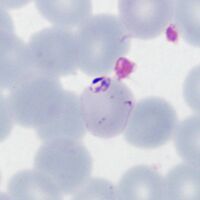
Accolé and double dot forms
-

Multiple parasite form


"